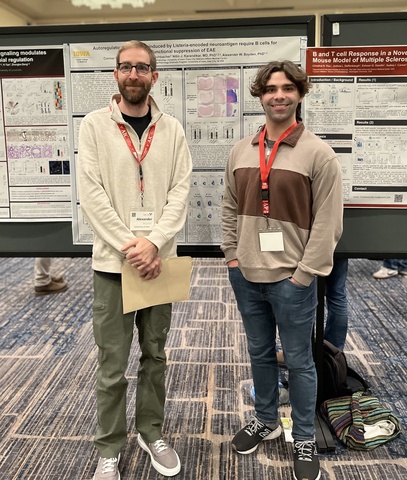
Connor Wilhelm, MS, Experimental Pathology PhD candidate in Alexander Boyden, PhD’s lab, has received a trainee travel grant from the Center for Immunology and Immune Based Diseases. The travel grant will cover the costs of registration, travel, and lodging associated with attending scientific conferences over the next year.
Connor’s abstract and presentation entitled “Targeting CD74 selectively suppresses B cell-dependent CNS autoimmunity” were competitively selected for recognition by program organizers at the 2026 Center for Immunology Retreat. Connor’s research focuses on leveraging single cell RNA sequencing to identify pathogenic B cell genes of interest for targeting in vivo and validating pre-clinical therapy potential. Results have implications for the identification and targeting of pathogenic B cells while sparing non-pathogenic B cells in people with MS. Connor and Dr. Boyden thank Mohan Kumar and Drs. Nitin Karandikar, Ashutosh Mangalam, Kathryn Eschbacher, Kai Rogers, Rachel Fitzjerrells, and Rama Sompallae for key contributions to the project.
The full abstract can be read below:
Targeting CD74 selectively suppresses B cell-dependent CNS autoimmunity
Connor R. Wilhelm1,2, Mohan Kumar1, Kai J. Rogers1, Rama R. Sompallae1, Kathryn L. Eschbacher1, Nitin J. Karandikar1,2,3, and Alexander W. Boyden1,2
1Department of Pathology, University of Iowa Health Care, 2Experimental Pathology PhD Graduate Program, Carver College of Medicine, University of Iowa, 3Iowa City Veterans Affairs Medical Center
B cells pathogenically contribute to multiple sclerosis (MS), an immune-mediated demyelinating disease of the central nervous system (CNS), as their removal by anti-CD20 mAb depletion therapy successfully treats disease symptoms. However, mechanisms remain unclear despite growing evidence of autoreactive CD4 T cell support. To better investigate pathogenic B cell:CD4 T cell interactions, we developed a B cell-dependent, Ab-independent experimental autoimmune encephalomyelitis (EAE) mouse model driven by a designed peptide spanning the extracellular domains of myelin proteolipid protein (PLPECD), where neuroinflammation and demyelination require B cell-mediated antigen presentation to CD4 T cells. This novel model contrasts with the majority of EAE studies driven by small myelin peptides like MOG35-55 or PLP178-191, which do not require B cells. Given this differential necessity for B cells, we predicted transcriptomic differences would exist between B cells isolated from PLPECD (B cell-dependent) and PLP178-191 (B cell-independent) immunized mice, specifically regarding genes associated with antigen presentation. Analysis of differentially expressed genes between B cells sourced from PLPECD and PLP178-191 immunized mice through both bulk and single cell RNA sequencing identified the invariant chain gene (CD74) as significantly upregulated in PLPECD B cells. CD74 plays a critical role in the assembly of MHC class II but can also act as a signaling receptor for macrophage migration inhibitory factor (MIF). Here, we observed that administering an anti-CD74 mAb robustly protected mice from B cell-dependent EAE (PLPECD) but not B cell-independent EAE (PLP178-191). This was confirmed by observing significantly less neuroinflammation, demyelination, and axonal swelling upon histopathologic analysis of lumbar spinal cord sections. Additionally, splenic CD4 T cells from treated PLPECD EAE mice displayed a significantly reduced recall IFNγ response ex vivo that was not observed in the PLP178-191 condition. Notably, anti-CD74 mAb treatment did not deplete B cells, suggesting that targeting CD74 selectively disrupts pathogenic B cell activity, possibly leaving other antigen presenting cells like dendritic cells unperturbed. Ongoing experiments are investigating phenotypic and functional changes in the B cell compartment upon CD74 targeting, including altered transcriptomic profiles. Future experiments aim to test antigen presentation function of human B cells in the presence of anti-CD74 mAb. Therapeutic potential is also being studied, where preliminary evidence suggests anti-CD74 mAb reverses established EAE.