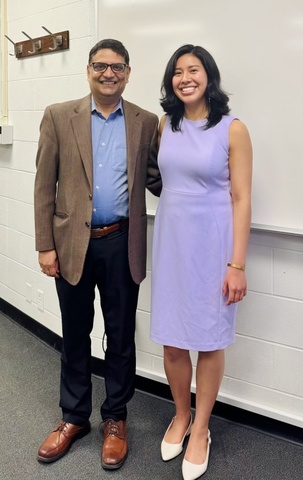
Aracely Miron-Ocampo successfully defended her M.S. thesis on April 13th, 2026, completing the Pathology M.S. program. Aracely’s thesis is titled Profiling the Nasal Microbiome in People with Multiple Sclerosis. Her thesis work was performed in the laboratory of Ashutosh K. Mangalam, PhD where she identified that people with relapsing remitting multiple sclerosis (RRMS) had a distinct nasal microbiome.
Globally, multiple sclerosis (MS) affects an estimated 2.9 million people with a prevalence of nearly 1 million people in the United States, where it is recognized as one of the most common causes of non-traumatic neurological disability in young adults. Although the exact cause of MS is unknown, a combination of both genetic and environmental factors is involved including the human microbiome. While previous research in the Mangalam lab has established important links between MS and the gut and oral microbiomes, Aracely’s work was focused on the nasal cavity, a critical but understudied mucosal site. Despite its direct anatomical proximity to the brain via the olfactory system, the nasal microbiome has remained largely unexplored in MS research until now.
Aracely’s research demonstrated that people with MS have an altered nasal microbiome characterized by lower bacterial richness and phylogenetic diversity compared to healthy individuals. The study identified an enrichment of specific bacteria in the MS group, including Staphylococcus caprae and Staphylococcus epidermidis, which are often commensal but can become opportunistic under conditions of altered host immunity. Conversely, healthy individuals showed an enrichment of beneficial microbes like Veillonella, Haemophilus, and Neisseria genera, which are typically involved in maintaining a balanced mucosal environment. A major highlight of this work is the discovery of seasonal fluctuations, showing that the decline in bacterial richness in people with MS was most pronounced during the spring and summer. This discovery is particularly impactful as these periods of significant microbial shift coincide with the peak seasons for disease flare-ups typically observed in the MS population.
In summary, Aracely’s thesis represents a first step toward characterizing the importance of the nasal microbiome in the pathobiology of MS. Her findings serve as a springboard for future studies aimed at determining the specific mechanisms through which the nasal microbiome plays a role in the nasal-brain axis. In addition to Dr. Mangalam and Drs. Alexander Boyden and Dustin Bosch served on the thesis committee. These findings are currently being prepared for publication.